

Understanding Trigger Points in the Biceps Brachii and Their Impact on Shoulder Pain
Trigger points are hyperirritable spots in skeletal muscle that are associated with palpable nodules in taut bands of muscle fibers. These points can refer pain to other areas, leading to discomfort and complications. One such area involves trigger points in the biceps brachii, a muscle located in the upper arm.
Anatomy of the Biceps Brachii
The biceps brachii consists of two heads: the long head and the short head. The biceps brachii is primarily responsible for elbow flexion and supination of the forearm. Its origin at the scapula and insertion at the radius (short head) allows it to have a significant role not only in arm movement but also in stabilizing (long head) the shoulder joint.
Trigger Points in the Biceps Brachii
When trigger points develop in the biceps brachii, they can evoke pain not only in the muscle itself but also in surrounding areas. Common causes of trigger points include:
- Overuse during activities such as weightlifting or repetitive overhead movements
- Poor posture that places undue stress on the shoulder girdle
- Trauma or direct injury to the arm or shoulder area
Referral Patterns
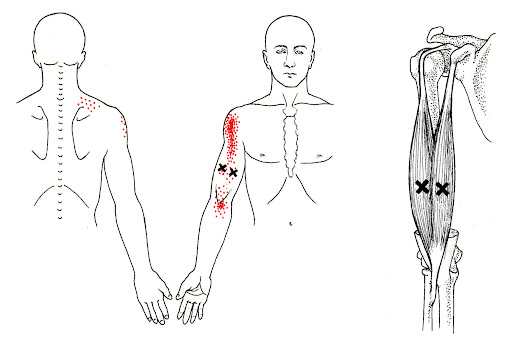
Image courtesy of Travell, Janet; Simons, David. Travell and Simons’ Trigger Point Flip Charts (p. 8). LWW. Kindle Edition.
One of the key characteristics of trigger points is their referral pattern. When trigger points form in the biceps brachii, they can refer pain to:
- The shoulder region
- The elbow region
Referral in the shoulder can lead to discomfort that may feel like it originates from within the shoulder joint.
How Bicep Trigger Points Cause Pain Near the Scapula and Humerus
The scaption (scapular plane elevation) during shoulder movements engages the biceps brachii and can aggravate any existing trigger points, leading to pain in these areas. The pain may manifest as:
- Sharp pain in the shoulder
- Difficulty with overhead movements
As the muscles around the shoulder region tighten in an attempt to compensate for the pain, this can further aggravate the discomfort and limit range of motion.
Management and Treatment
Effective management of trigger points in the biceps brachii often includes a combination of:
- Rest and Recovery: Allowing time for the muscle to heal and reducing activities that exacerbate pain.
- Physical Therapy: Engaging a professional can help in utilizing specific exercises and stretches to release tension.
- Manual Therapy: Techniques such as deep tissue massage can directly target trigger points, helping to alleviate pain and restore function.
- Posture Correction: Adjusting posture during daily activities can prevent the recurrence of trigger points.
- Use of Heat or Ice: Applying heat can promote blood flow to the muscle, while ice can reduce inflammation during acute flare-ups.
Conclusion
Understanding the relationship between trigger points in the biceps brachii and shoulder pain is an option for effective treatment. By recognizing the symptoms and employing appropriate therapeutic strategies, individuals can significantly reduce discomfort and improve their shoulder mobility. Early intervention and a proactive approach to stretching and strengthening exercises can help prevent the formation of new trigger points, promoting long-term shoulder health.